
The Pickaxe Mountain Dilemma: When a War Reveals Its Own Limits
Adaptive Terrain Institute | July 24, 2026

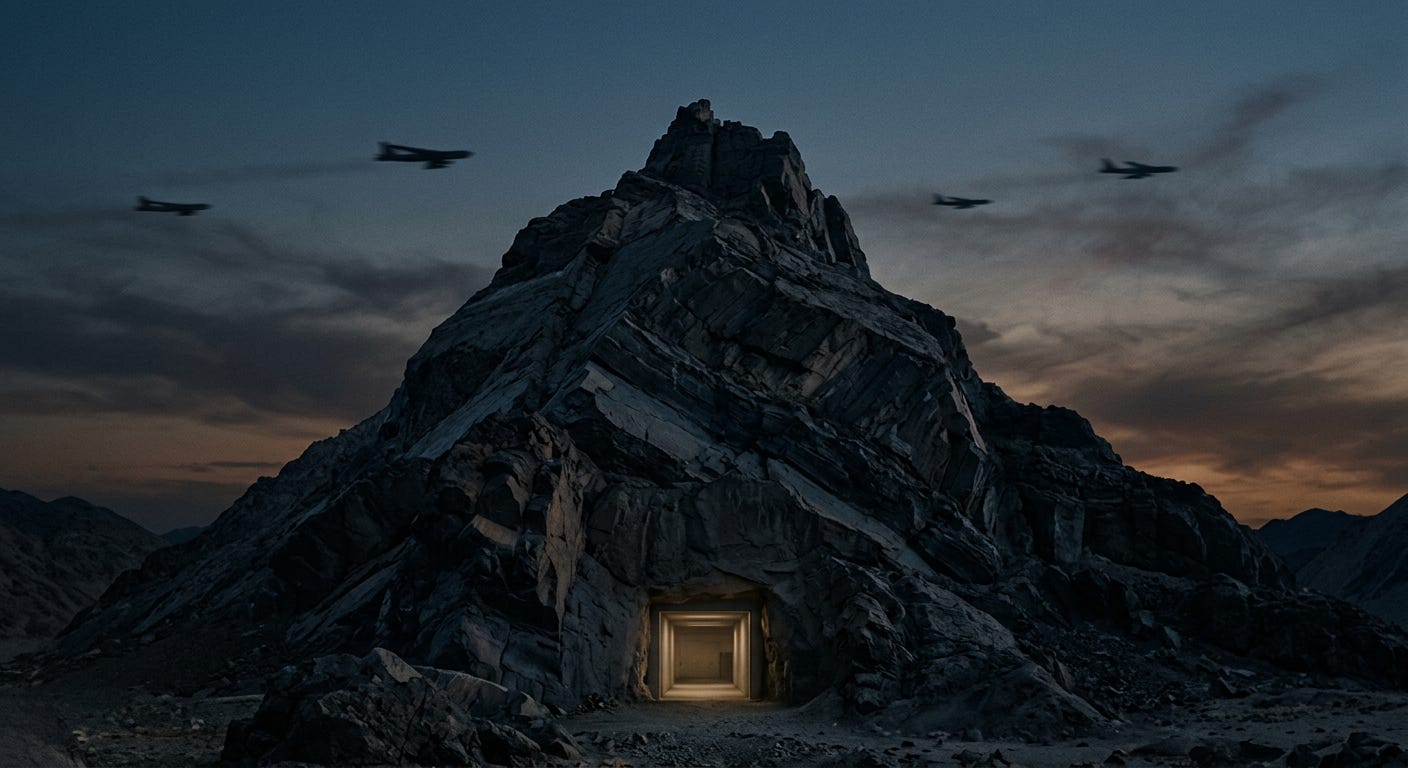
The war has entered a phase where the terrain itself is beginning to speak — not metaphorically, but strategically. Overnight, a single development reframed the entire conflict: Israel now assesses that Iran has moved active nuclear centrifuges into Pickaxe Mountain, a site already named by Washington as a near‑term strike target.
This is the moment when a campaign’s declared intent collides with its demonstrated limits.
As I wrote in the internal dispatch:
“A suspected empty hardened facility and a facility assessed to contain operational centrifuges are different categories of target.”
That difference is not incremental. It is categorical. And it is the hinge on which this entire phase of the conflict now turns.
I. When a Mountain Becomes a Message
Pickaxe Mountain began this week as a suspected underground facility — nuclear‑adjacent, hardened, but not confirmed to house active enrichment infrastructure. Overnight, that changed. Israel’s assessment that centrifuges have been moved directly into the mountain transforms the site from a potential target into a strategic dilemma.
Why? Because Iran appears to have made a choice that is both tactical and symbolic: relocate critical nuclear infrastructure into a site that may have been selected precisely because earlier conventional strikes failed to fully destroy a comparable facility.
In HD‑19, I put it plainly:
“If Iran relocated centrifuges into Pickaxe Mountain because earlier conventional strikes… were assessed… as insufficient… then any operation aimed at Pickaxe Mountain faces this same question at a plausibly harder target.”
This is not a technical problem. It is a strategic fact.
And it is the kind of fact that forces planners, analysts, and political leaders into a narrow corridor of options — none of which can be named lightly.
II. The Ghost of Fordow
The unresolved question from the Fordow strike now returns with sharper teeth.
Public reporting after the GBU‑57 strike on Fordow revealed genuine disagreement — including within the U.S. intelligence community — about whether the strike destroyed Iran’s centrifuge infrastructure or merely delayed it. That disagreement was never resolved. It simply faded into the background as the war escalated elsewhere.
Iran’s relocation decision brings it roaring back.
If Tehran concluded the Fordow strike did not achieve its intended destruction, then Pickaxe Mountain is not just a hardened site. It is a hardened site chosen in response to a demonstrated limitation of conventional force.
This is the war speaking to itself.
And it is why HD‑19 deliberately refused to estimate what would be required to neutralize the capability now housed inside the mountain. That refusal is part of the analytical discipline:
“This dispatch does not estimate what force would be required… and deliberately declines to.”
Substack readers deserve the same clarity: the dilemma is the point, not the solution.
III. The Signals That Matter Now
Rather than speculating about capability, the terrain offers observable signals — public, trackable indicators of where this is heading. These signals do not require classified insight or technical estimation. They require attention.
1. Platform Escalation
A B‑1 strategic bomber was used in strikes for the first time this cycle. This is not cosmetic. It is a heavier, longer‑range platform than has defined the campaign’s prior nights. Continued use of such platforms would indicate a shift toward a more aggressive conventional posture.
2. Official Rhetoric
Watch the verbs.
“Finish” versus “degrade.”
“Neutralize” versus “delay.”
Confident language signals belief in conventional sufficiency. Hedged language signals the opposite.
3. Comparative Hardening Statements
Any public characterization of Pickaxe Mountain’s hardening relative to Fordow’s is directly relevant. These statements are rare, but when they appear, they are revealing.
4. Civilian Preparedness Measures
Tel Aviv opened civilian shelters overnight. Iran issued an unusual advance warning urging civilians to avoid U.S. troop accommodation sites. Civil defense postures are costly. They are not adopted for rhetorical effect.
These signals form the open‑source terrain map of the dilemma.
IV. The Ledger: A War Becoming Its Own Economic Event
The cost reconciliation is stark. The war now stands at nearly $110 billion to date. The administration is requesting an additional $67 billion. If approved, total spending approaches $177 billion — a trajectory sharply higher than anything cited even two days ago.
This is not merely fiscal. It is political terrain.
And that terrain is fracturing.
V. Congress Breaks in a New Place
The annual defense policy bill — historically one of the most bipartisan pieces of legislation Congress produces — passed on a near‑party‑line vote. This is not the war‑powers oscillation HD‑15 and HD‑18 tracked. It is a new fracture, spreading into adjacent legislative territory.
When bipartisan consensus breaks in a domain that has historically been insulated from war‑related strain, it signals that the conflict is beginning to reshape the political architecture around it.
This is how wars metastasize institutionally.
VI. The Dilemma, Named Plainly
Pickaxe Mountain now reportedly holds what Fordow was struck to eliminate. It holds it because the earlier strike may not have fully succeeded. And it holds it inside a site plausibly chosen because it is harder to reach.
This is the dilemma:
“The declared intent to strike this site now exists alongside a real, previously demonstrated, and still publicly unresolved question about whether conventional force is equal to the task.”
The gap between intent and capability is the terrain variable to watch.
Not the ordnance.
Not the platforms.
Not the classified estimates.
The gap.
And whether that gap closes through conventional escalation, repeated strikes, or a threshold this series has previously declined to treat as a live probability — that is the open question.
It should be tracked through public signals, not predicted in advance.
VII. What This Moment Actually Means
For Substack readers who track geopolitical terrain rather than tactical minutiae, the Pickaxe Mountain dilemma is a case study in how wars reveal their own limits. It is a moment when strategic intent encounters hardened reality — literally.
It is also a moment when political, economic, and civil‑defense signals begin to align around a shared recognition: the next phase of this conflict may require choices that cannot be disguised as continuity.
This is not a prediction.
It is a recognition of the terrain.
And terrain, once named, cannot be unnamed.
About the Author:
Marcus Robinson is the founder of the Adaptive Terrain Institute and a leading voice in the emerging field of multisystem human ecology. His work blends scientific rigor, ancestral intelligence, and systems‑level analysis to map how individuals and civilizations adapt under stress. A longtime strategist, educator, and movement architect, Marcus helps leaders navigate complexity by revealing the hidden terrains—biological, psychological, relational, and civilizational—that shape human behavior and collective futures. His writing invites readers into a deeper coherence, where personal transformation and societal evolution become part of the same living system.