

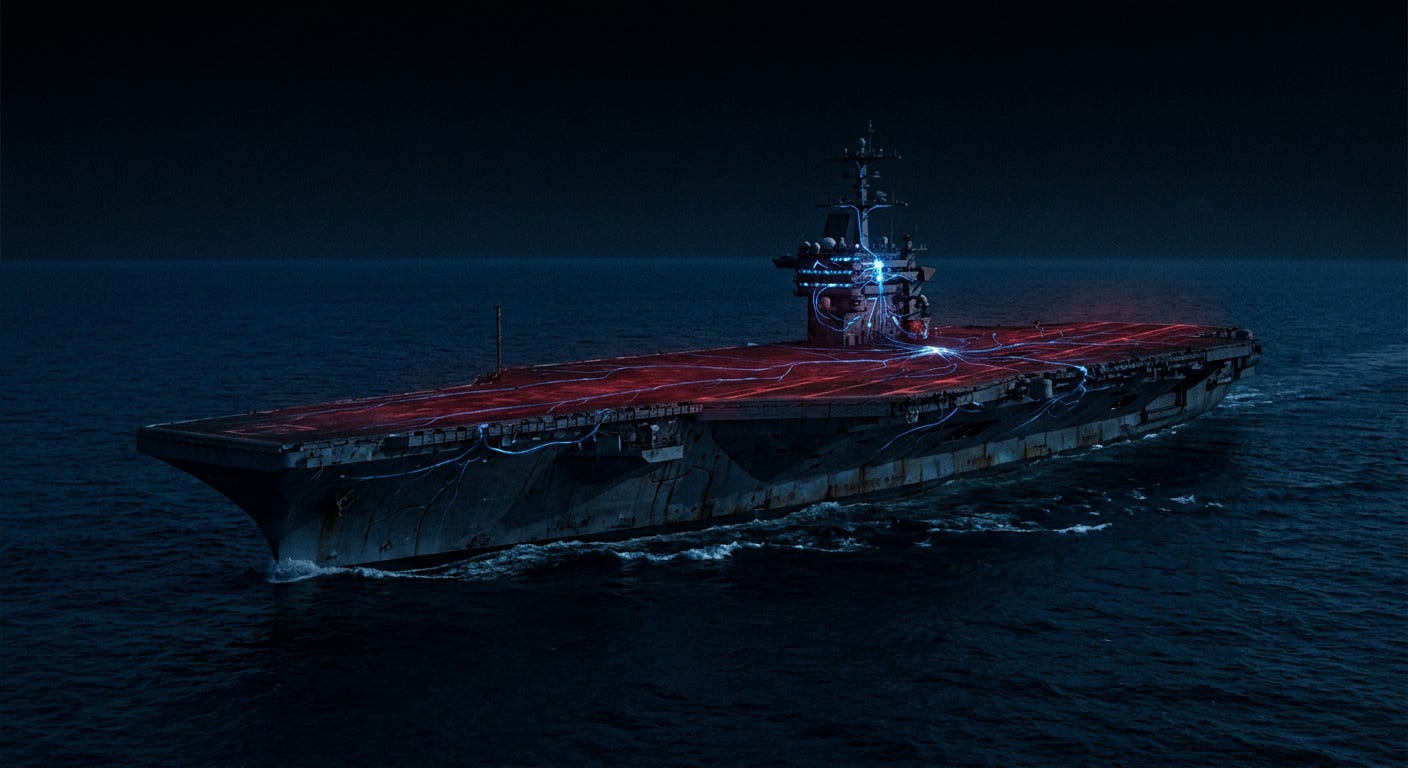
The Ship That Made the Invisible Visible
Every so often, a system breaks in public — not metaphorically, but literally, with names, dates, ships, and congressional hearings. When that happens, you get a rare diagnostic window into something much larger than the event itself.
This summer, the U.S. Navy gave the country such a window.
“The USS Abraham Lincoln had logged more than 250 consecutive days at sea… The USS Gerald R. Ford was on a trajectory toward 300 days — deployment lengths not seen since Vietnam.”
The reporting was unambiguous: suicidal ideation, sailors attempting to jump overboard, emergency rescues, food shortages, water contamination, broken sanitation. A fleet stretched past the point where human systems can sustain themselves.
The Navy’s crisis is not the story.
It is the instrument that makes the real story visible.
What broke on those carriers is the same thing breaking across the civilian population — just without the ship, without the chain of command, without the congressional hearing, and without a name.
The Human Duty Cycle
Stress physiology has a precise term for what happened on those ships: allostatic overload. Human systems can sustain elevated demand. They are built for that. What they cannot sustain is elevated demand without recovery.
“Port calls… are physiological and psychological maintenance intervals. Remove them, and you are… running the system past its duty cycle.”
The Navy didn’t break because it deployed its carriers.
It broke because it eliminated the reset interval.
Every human system — military, civilian, biological, organizational — has a duty cycle. Exceed it long enough and the system fails. Not gradually. Not politely. Suddenly, and often catastrophically.
The sailor at the rail is not the surprise.
The surprise is that anyone thought the system could hold.
The Civilian Parallel: A Country Without Port Calls
The American civilian population is running the same protocol — not by military order, but by cultural architecture.
The forty‑hour week, the sabbath, the season of rest, the vacation: these were not sentimental traditions. They were maintenance intervals. They were the civilian version of port calls.
We eliminated them.
We compressed them, monetized them, guilt‑loaded them, and in many cases erased them entirely. The result is a population running extended deployments in work, caregiving, financial precarity, and relational complexity — without recovery, without acknowledgment, and without a name for the condition.
“The Navy is the diagnostic window. The country is the patient.”
The Logistics Collapse No One Reports
On a carrier, logistics collapse is visible: broken toilets, contaminated water, food shortages. You can photograph it. You can report it.
In civilian life, logistics collapse is slow, distributed, and profitable — which means it never becomes a crisis.
“Ultra‑processed foods engineered for consumption rather than nourishment.”
“Water contamination — PFAS, microplastics, agricultural runoff.”
“A population‑wide sleep deficit whose cognitive and immunological consequences compound daily.”
These are not discrete issues. They are structural conditions that degrade human terrain the same way broken sanitation degrades a ship.
The difference is that no one calls a hearing when the country’s sleep architecture collapses.
The Cascade That Looks Like Personal Failure
When overclocked sailors return home, they collide with family systems that adapted to their absence. Reintegration is not a reunion — it is a negotiation between two systems that changed in parallel.
“The period following extended deployment is the peak window for domestic conflict, family violence, and divorce filing.”
Now scale that pattern across 330 million people.
Extended deployments in economic stress.
Extended deployments in caregiving.
Extended deployments in psychological load.
No port calls.
No reintegration support.
No language for the accumulated cost.
The outputs look like personal failure: divorce, withdrawal, addiction, collapse. But they are not personal failures.
“They are system failures expressing through the individuals who happen to be the containers.”
The person who breaks is not the problem.
They are the signal.
The Unnamed Condition
The Navy has ships, commanders, oversight committees, and doctrine. When something breaks, it can be named.
Civilian life has none of that.
“There is no commanding officer of the American nervous system.”
So when a person experiences cognitive fog, motivational collapse, relational fracture, or somatic symptoms, they interpret it as personal inadequacy. The system’s failure becomes the individual’s shame.
This misattribution is not incidental.
It is the mechanism by which the system sustains itself.
As long as people believe their breakdown is a personal flaw, the structural conditions remain untouched.
The Health Span Consequence
The biological record is unambiguous. Sustained allostatic overload accelerates aging. Telomere attrition. Mitochondrial dysfunction. Immune dysregulation. Chronic inflammation.
“The American health span crisis… is not primarily a disease problem. It is a recovery architecture problem.”
We are running the overclocked fleet protocol at the cellular level.
The medical system treats the terminal expression — the diagnosis — without addressing the trajectory that produced it. It is the clinical equivalent of treating the sailor’s mental health crisis without addressing the 300‑day deployment.
What Would Change the Diagnosis
The Navy will be forced to reassess deployment doctrine. Human systems have duty cycles. Exceed them and you break the system.
The civilian world has not yet made that reassessment.
It exists in pockets — in research on rest and recovery, in clinical practices that read terrain rather than symptoms, in cultural movements that revalue restoration.
What it lacks is a frame legible enough to enter institutional architecture.
“The frame exists. It has not yet been widely deployed.”
The question is whether the Navy’s moment of visibility can be used to make the civilian condition visible — not as a military story, but as a human systems story.
Two Registers of Address
For the Individual
If you recognize yourself in this — the fatigue that sleep does not resolve, the sense of carrying more than the design intended — the interpretation matters.
“You are not the problem. You are the signal.”
Your condition is real. Its causes are structural.
For the Institutional Leader
If you lead people, you are managing human systems with duty cycles. They are not abstractions. They are biological realities.
“The question is not whether you care about your people. The question is whether your operational decisions account for the duty cycle of the human systems you depend on.”
The Navy is the diagnostic window.
What you see through it is your own organization.
Closing Altitude
The overclocked fleet is not an anomaly. It is a mirror.
A nation that eliminates its recovery architecture will eventually produce the same outputs the Navy produced — just without the carrier to make the crisis visible.
The question is whether we can read the signal before the system fails in ways that cannot be ignored.
About Marcus Robinson
Marcus Robinson is the founder of the Adaptive Terrain Institute, where he leads the emerging field of multisystem human ecology — the study of how individuals, institutions, and civilizations adapt under stress across biological, psychological, relational, and geopolitical terrains. His work integrates scientific rigor with ancestral intelligence and systems‑level analysis to reveal the hidden structures shaping human behavior and collective futures.
On August 20 I'm opening my working territory.
For those who've been following the HINGE bulletins, the ATT framework, or the conversations about terrain, coherence, and what organizations and communities actually require to function at their potential — this is the room where that work is live.
Adaptive Terrain Theory Open House | August 20 | Zoom | 7PM EST
Here's what we'll do:
→ I'll present the framework — not as a lecture, but as a working map you can orient by
→ You'll share one aspect of your current work that has you genuinely excited
→ I'll engage with what you bring — a terrain-based read that deepens rather than summarizes
→ Everyone leaves with the ATT Field Book
→ One-on-one conversations available for those ready to go further
The people already confirmed for the room are doing work at the edge of civic transformation, organizational design, community development, and human performance. The conversation will be worth your time.
This isn't a pitch. It's a working session for people building what comes next.
If that's you — DM me for the link.