

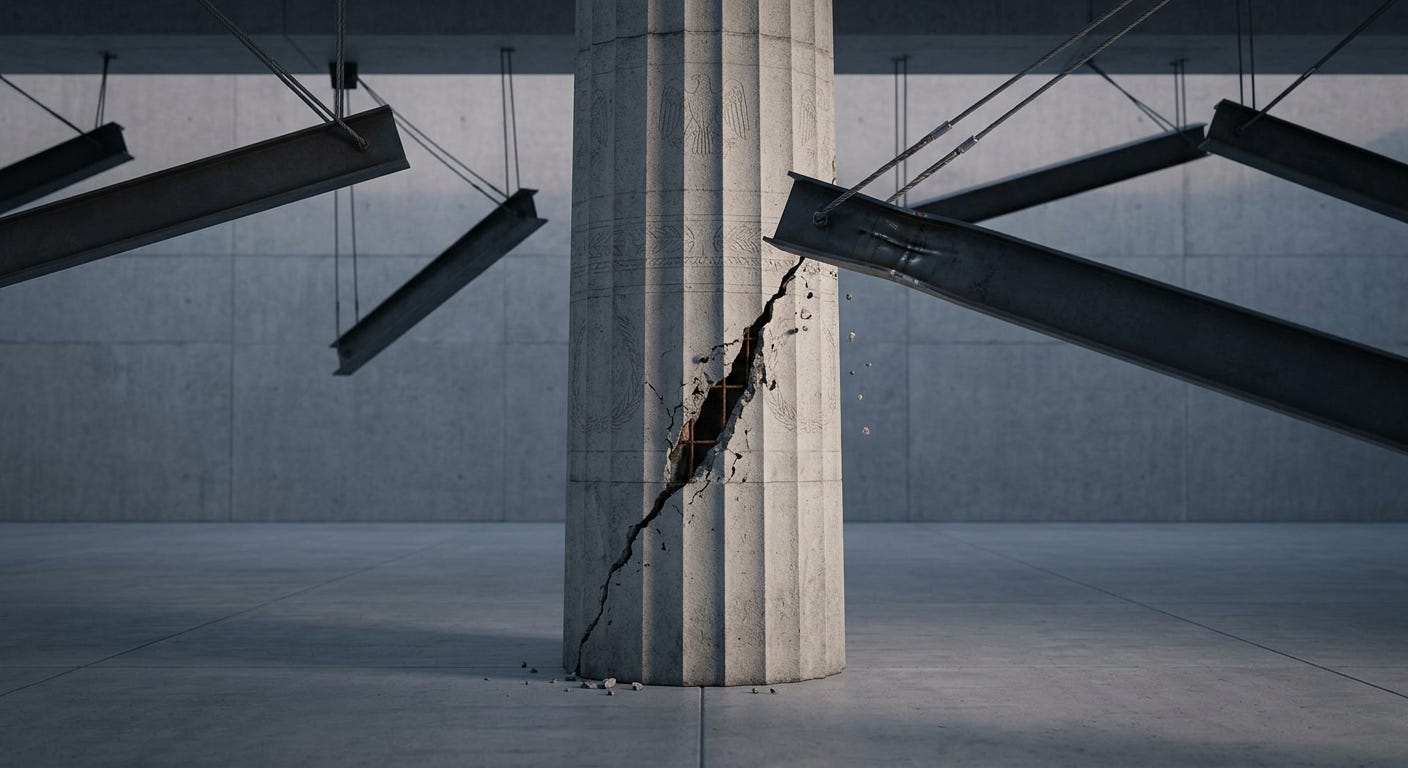
America has crossed a line. Not a symbolic line, not a rhetorical line — a structural one. You can feel it in the background hum of the news cycle, in the way allies speak more cautiously, in the way markets twitch at every signal. Something fundamental in the global system has shifted, and the shift is coming from inside the system’s historical center of gravity.
The technical read is simple and devastating: the U.S. Apex Apparatus — the institutional, alliance, financial, and normative architecture built over eight decades — is being dismantled at political speed under TrumpMAGA governance. The speed is not accidental. It is the strategy.
For the first time in modern history, the world’s load‑bearing node is not being attacked. It is withdrawing itself while every dependent system remains fully attached.
This is the threshold moment.
The World Is Moving All at Once
HD‑32 describes a rare global condition: multi‑fault activation — multiple geopolitical stress zones entering active movement in the same window. What makes this moment different is that all those zones rely, directly or indirectly, on U.S. stability as their load distributor.
And that distributor is now intentionally stepping back.
Eurasia
The Russia‑Ukraine war is no longer just a conflict. It is a forced transfer of security responsibility onto European states that have not finished building the architecture required to carry it. Germany and Poland are now the primary columns. Neither is structurally ready.
Europe / NATO
The alliance is settling unevenly — different members sinking or shifting at different rates under the same pressure. Europe is talking about “strategic autonomy,” but talk moves at political speed while capacity moves at institutional speed. Fracture begins in the gap.
Middle East / Hormuz
This is the highest‑volatility node in the global system. A disruption in the Strait of Hormuz — under conditions of U.S. strategic ambiguity — would not be a regional crisis. It would be a global cascade: energy shock, financial shock, alliance shock, supply chain shock, all at once.
Asia‑Pacific
Japan’s rearmament is the most significant structural shift in the Pacific in 75 years. South Korea and Australia are hedging. Taiwan remains the single highest‑consequence node on the planet. All of this is happening under conditions of eroding U.S. alliance credibility.
Global South
The only zone currently building coherence. BRICS+ expansion, Gulf state repositioning, African Union infrastructure development — these are not ideological moves. They are rational terrain moves made possible by apex confusion.
The Speed Gap That Creates Cascades
The danger is not the dismantling itself. It is the speed asymmetry between three processes:
Apex deconstruction moves at political speed — fast, discontinuous, and irreversible in consequence
Replacement architecture moves at institutional speed — slow, cumulative, coherence‑dependent
Load redistribution moves at market and conflict speed — immediate, nonlinear, indifferent to intent
Cascades live in the gap between those speeds.
No actor — not the U.S., not Europe, not China, not the Gulf, not India — has the adaptive capacity to close that gap in real time. This is not a transition. It is a terrain bifurcation event: a fork in the global load path whose outcome is not yet determined.
The U.S. Fracture: What It Means
The U.S. is not losing power through external defeat. It is shedding the architecture that made its power load‑bearing: alliance trust, institutional predictability, financial coherence, normative stability.
Once trust architecture collapses, it does not return on demand. It must be rebuilt, and rebuilding moves at institutional speed — far slower than political dismantling.
This is why the moment feels different. Because it is.
Who Can Absorb the Shock?
Actors with internal coherence, flexible alliances, and resources not denominated in U.S. trust architecture have the most adaptive capacity right now: India, the Gulf states, selective ASEAN nodes, and a constrained China.
They are not replacing the U.S. apex. They are absorbing released energy from its withdrawal.
The Real Question for Institutions, Cities, Enterprises, and Citizens
The question is no longer when does stability return.
The question is:
What load can your terrain actually carry — and are you building the architecture to carry it before the next transfer arrives?
This is the civic, organizational, and strategic work of the next decade. Not predicting the next crisis, but building coherence before the next load shift.
About Marcus Robinson
Marcus Robinson is the founder of the Adaptive Terrain Institute, where he leads the emerging field of multisystem human ecology — the study of how individuals, institutions, and civilizations adapt under stress across biological, psychological, relational, and geopolitical terrains. His work integrates scientific rigor with ancestral intelligence and systems‑level analysis to reveal the hidden structures shaping human behavior and collective futures.
As a strategist, educator, and movement architect, Marcus helps leaders navigate complexity by mapping the deep terrains beneath events: the coherence fields, developmental geometries, and civilizational dynamics that determine whether systems fracture or evolve. His writing invites readers into a higher‑order clarity where personal transformation and societal evolution are understood as expressions of the same living system.
Contact:
For collaboration, advisory work, or speaking engagements, reach Marcus at DrMarcusCoaching@Gmail.com or through the Adaptive Terrain Institute at www.AdaptiveTerrainTheory.com.