

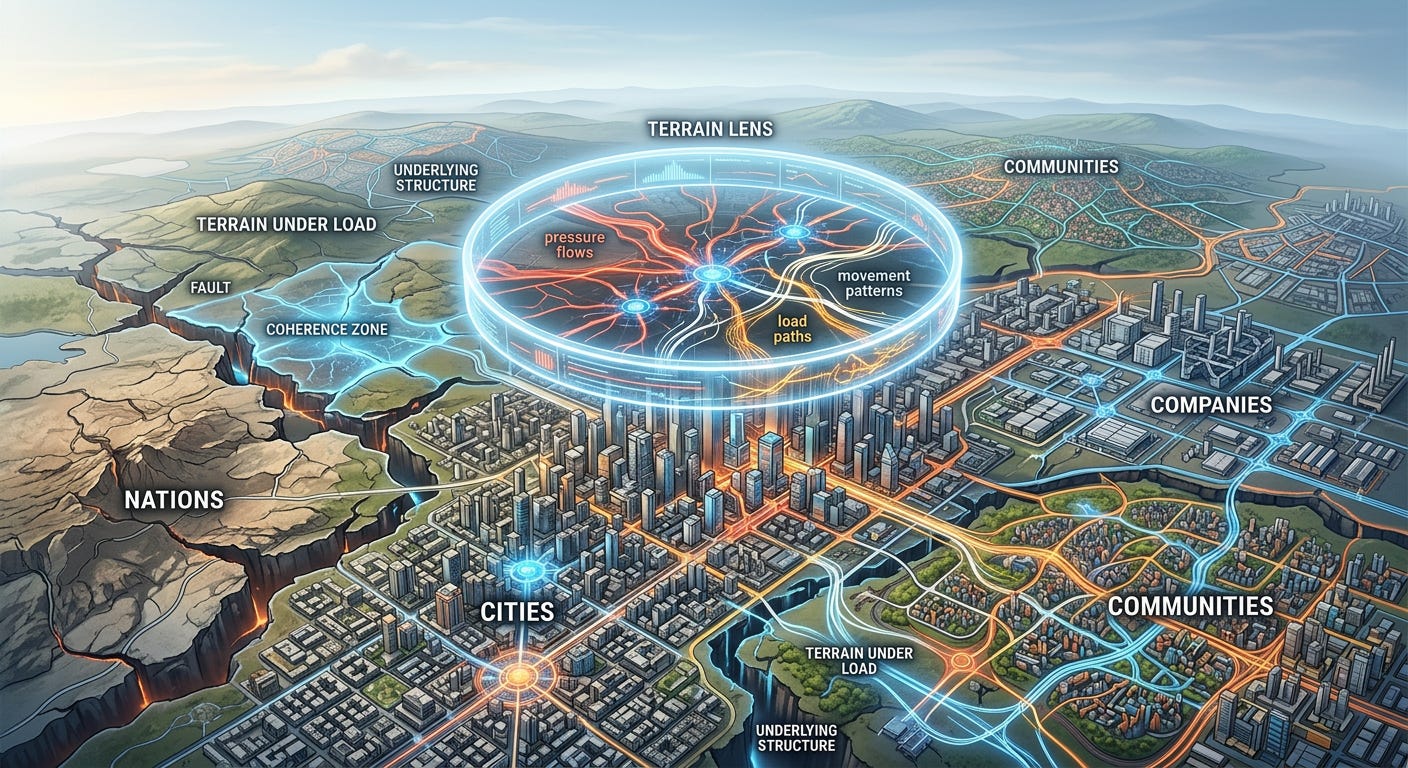
Most people feel the world shifting long before they can explain why. Prices jump, institutions wobble, alliances strain, markets twitch, and communities feel stretched. Adaptive Terrain Theory (ATT) gives us a way to understand that feeling — by showing that every human system behaves like a terrain under load.
ATT begins with one simple idea:
Every human system — a nation, a city, a company, a community — is a terrain.
It has structure, pressure, fault lines, load paths, and movement patterns. And like physical terrain, it moves according to its architecture, not its intentions.
ATT is not a prediction tool. It is a structural lens. It explains why systems cohere, why they fracture, and why some actors thrive in instability while others collapse.
1. Terrain Is Structure, Not Story
Most analysis focuses on narrative — who said what, which ideology is rising, which leader is winning. ATT ignores narrative and looks at structure, because structure determines how pressure moves.
Every terrain has:
load‑bearing nodes
fault lines
coherence fields
adaptive capacity
Narratives can obscure these. Terrain reveals them.
2. Load Determines Movement
Systems move because load moves — economic load, security load, social load, institutional load. When load exceeds what the terrain can carry, movement begins: fracture, settlement, cascade, bifurcation.
ATT asks a simple diagnostic question:
What load is being placed on this terrain, and what architecture exists to carry it?
This is why ATT can identify instability before it becomes visible.
3. Coherence Is the Only Real Power
In ATT, power is not dominance, wealth, or military strength.
Power is coherence — the ability to absorb pressure without losing structural integrity.
A coherent actor redirects energy.
An incoherent actor transmits it.
A fractured actor amplifies it.
This explains why small actors sometimes outperform large ones, and why apex systems can collapse from internal decisions rather than external threats.
What ATT Actually Does
ATT gives you a way to read any system by asking four questions:
What is the terrain?
(Institutions, alliances, norms, resources)Where are the fault lines?
(Where movement begins under pressure)Where is the load?
(What weight the system is carrying right now)What is the adaptive capacity?
(Whether the system can absorb the next transfer event)
This diagnostic frame works at every scale:
global geopolitics
national governance
civic systems
enterprises
communities
individual leadership architectures
ATT is fractal: the same principles apply everywhere.
Why ATT Matters Now
We are living through a global moment defined by load transfer — energy moving rapidly across systems that were not designed to carry it. The U.S. apex withdrawal accelerates this movement. Europe, Asia, the Middle East, and the Global South are all experiencing differential settlement.
ATT gives people a way to understand what they are feeling:
the sense that the ground is shifting beneath them.
It explains:
why institutions feel brittle
why alliances feel uncertain
why markets feel jumpy
why civic trust feels thin
why global actors are repositioning so quickly
ATT is not a theory of crisis.
It is a theory of terrain under load.
The Essence in One Sentence
Adaptive Terrain Theory is a structural way of seeing human systems — how they carry pressure, how they move under load, and how coherence determines their future.
If this frame resonates and you’d like to explore how ATT applies to your organization, community, or leadership architecture, you’re welcome to reach out for a conversation with Dr. Marcus to learn more.
About Marcus Robinson
Marcus Robinson is the founder of the Adaptive Terrain Institute, where he leads the emerging field of multisystem human ecology — the study of how individuals, institutions, and civilizations adapt under stress across biological, psychological, relational, and geopolitical terrains. His work integrates scientific rigor with ancestral intelligence and systems‑level analysis to reveal the hidden structures shaping human behavior and collective futures.
As a strategist, educator, and movement architect, Marcus helps leaders navigate complexity by mapping the deep terrains beneath events: the coherence fields, developmental geometries, and civilizational dynamics that determine whether systems fracture or evolve. His writing invites readers into a higher‑order clarity where personal transformation and societal evolution are understood as expressions of the same living system.
Contact:
For collaboration, advisory work, or speaking engagements, reach Marcus at DrMarcusCoaching@Gmail.com or through the Adaptive Terrain Institute at www.AdaptiveTerrainTheory.com.